Ancient Chinese Myths and the Origins of Civilization
Discover how ancient Chinese myths, legends, and stories inspired early civilization, from farming and writing to the Great Wall and cultural traditions.
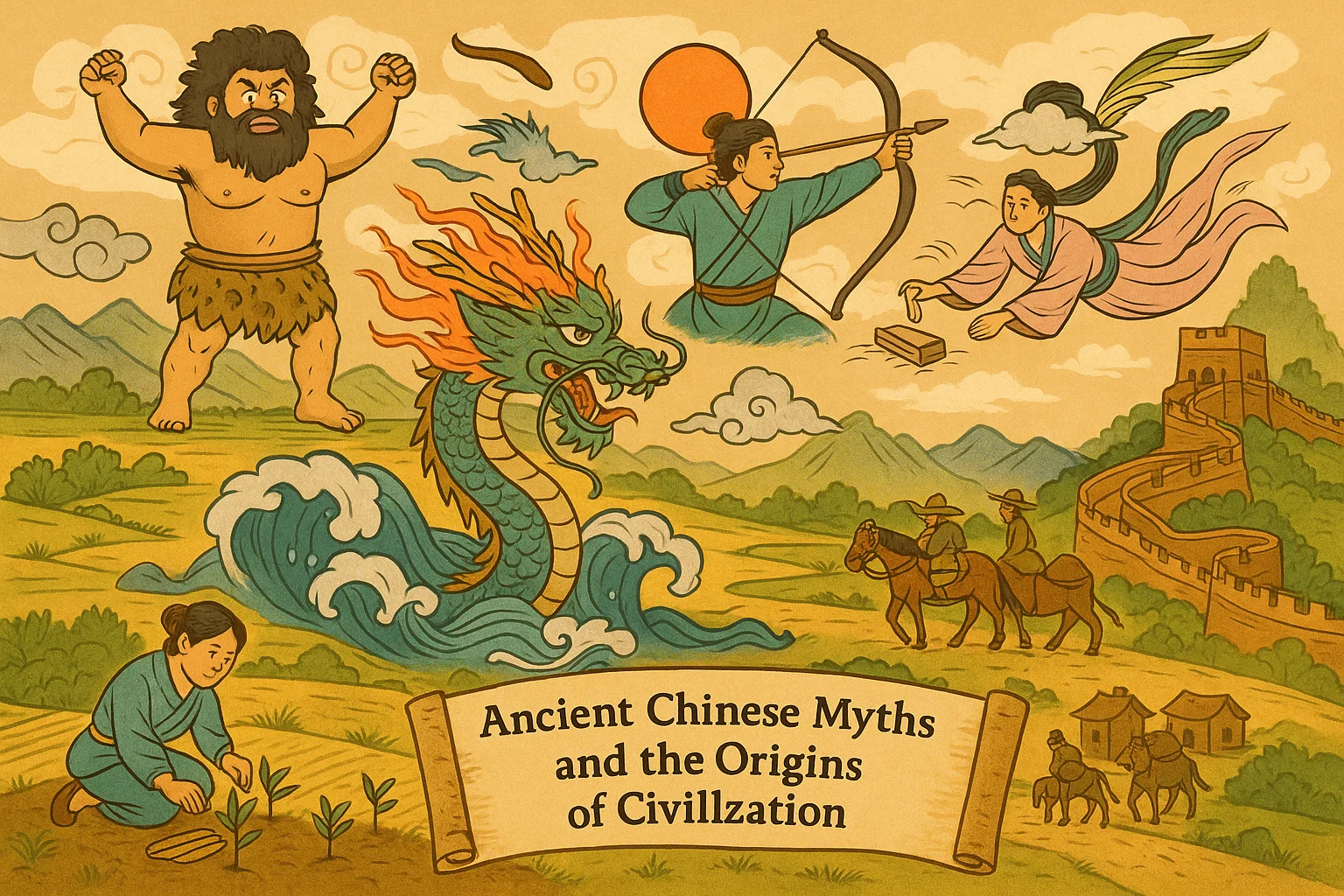
*A traditional illustration showing ancient Chinese myths and the origins of civilization, featuring legendary figures, dragons, early farming, and the Great Wall.
*
Ancient Chinese Myths and the Origins of Civilization
The roots of Chinese civilization are deeply connected with mythology and ancient imagination. Thousands of years ago, people lived along the Yellow River and the Yangtze River, surrounded by fertile land and natural resources. Without modern science, they explained the world through stories about gods, heroes, and powerful creatures. These myths not only entertained but also guided people’s lives, inspiring inventions, art, and culture that continue to shape China today.
---
🌞 Early Beliefs and Natural Worship
In ancient times, people respected the sun, moon, rivers, fire, and even animals and plants. They feared storms and lightning but also admired their power. To explain these natural forces, they created myths. For example, the dragon symbolized strength and protection, a creature that could control water and breathe clouds. Such stories gave comfort and also built a shared cultural identity.
---
🐉 Famous Legends and Heroes
Among the most famous stories are those of Pangu creating the world, Nuwa repairing the sky, and Fuxi teaching humans. These myths explained deep philosophical questions: What is the sky? Where does the earth come from? How did humans appear? The answers were found in the imagination of ancient people.
Other tales, like Hou Yi shooting down the suns or Jingwei filling the sea, became symbols of perseverance and courage. Artists, poets, and writers used these legends as inspiration for centuries, weaving them into literature, painting, and folk traditions.
---
🏯 From Myths to Civilization
Chinese mythology also connects directly to the rise of civilization. For example:
- Over 8,000 years ago, rice farming began in southern China.
- By 6,700 years ago, people in Shaanxi were already smelting bronze.
- Around 4,000 years ago, the Xia dynasty was founded in the Yellow River region.
- Emperor Qin later unified the nation, built the Great Wall, and laid the foundation for future dynasties.
These achievements were not only practical but also carried the influence of myth and imagination. Belief in divine guidance gave people strength to build, explore, and create.
---
🌏 Shared Wisdom of Many Ethnic Groups
Chinese civilization was never created by the Han people alone. More than 50 ethnic groups, including the Manchu, Mongol, Tibetan, and Hui, contributed to its diversity. Together they formed a cultural mosaic, enriched with language, rituals, and traditions. Myths and legends from different groups added layers of meaning, making Chinese culture both diverse and unified.
---
✨ Lasting Influence
The imagination of the ancients was the driving force of invention and the source of creativity. Myths and legends continue to inspire modern art, literature, and education. They remind us that civilization is not only about survival but also about dreams and stories passed down from generation to generation.
Today, Chinese culture remains vibrant and attractive to the world. From mythology to modern achievements, the journey of civilization shows the power of imagination in shaping human progress.
---
✍️ Written for LearnChineseUp.com
Comments
Loading comments...