Divine Figures in Chinese Religion: Guanyin’s Path and the Eight Immortals Crossing the Sea
Discover the legends of Guanyin’s journey to enlightenment and the Eight Immortals Crossing the Sea—two timeless tales from Chinese mythology that reflect compassion, wisdom, and the triumph of ordinary beings.
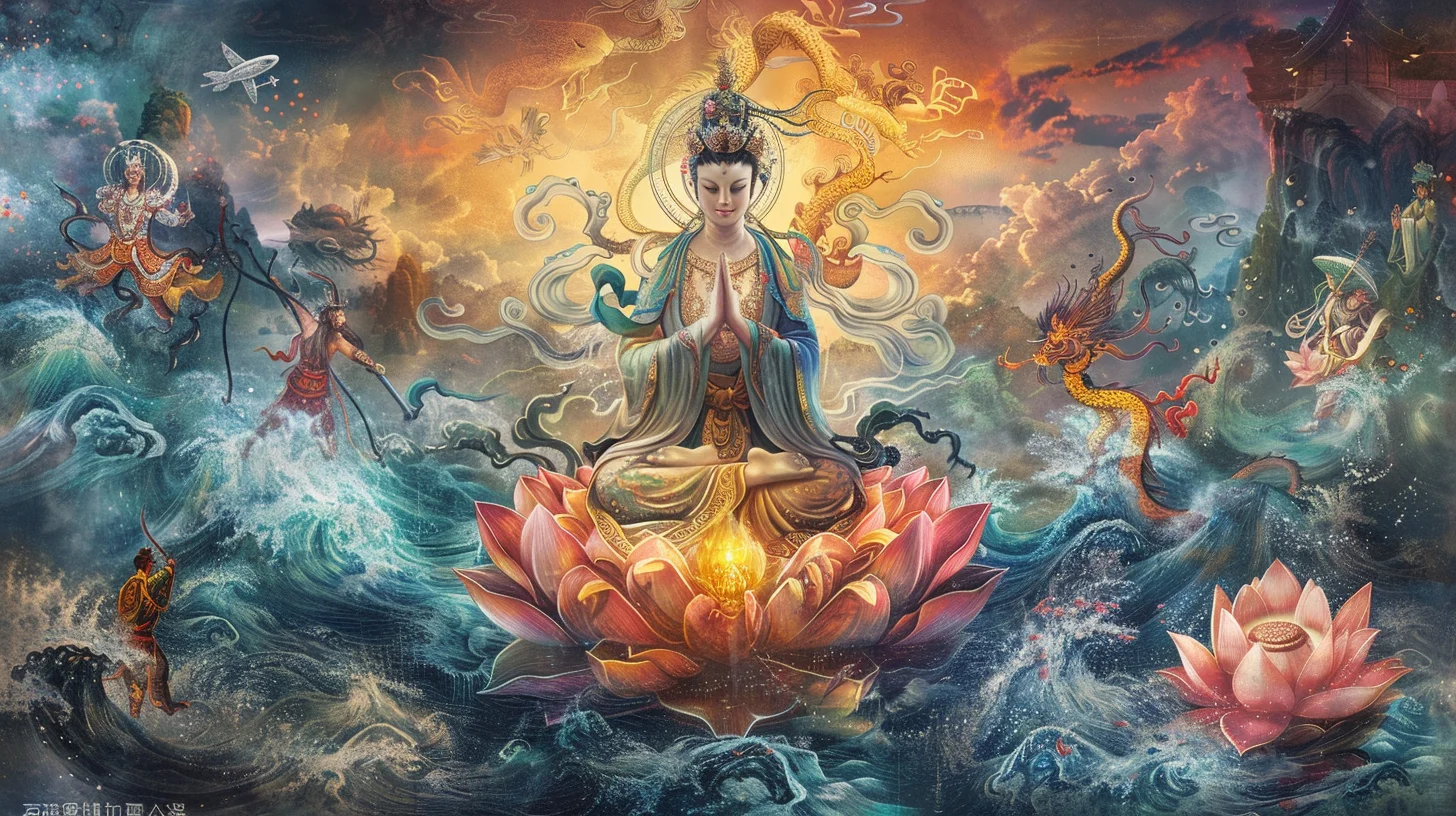
Artistic depiction of Guanyin with the Eight Immortals in Chinese mythology, showing them crossing the sea on lotus and clouds, symbolizing wisdom, harmony, and divine power.
Chinese mythology is not only filled with cosmic stories about the creation of the world but also with deeply human tales about compassion, morality, and the search for transcendence. Two of the most famous legends in this tradition are the story of Guanyin gaining enlightenment and the beloved adventure of the Eight Immortals Crossing the Sea. Together, these stories represent how faith and folklore have shaped Chinese culture for centuries.
Guanyin’s Path to Enlightenment
Guanyin, often called the Goddess of Mercy in English, is one of the most recognized figures in Chinese Buddhism. The story tells that before she became a divine bodhisattva, Guanyin lived among people, walking the world to relieve suffering.
One day, she descended to the human world and saw a poor peasant woman being chased by a ferocious tiger. The woman cried out desperately for help. Guanyin wished to intervene, but Buddha himself warned her: if her heart remained distracted—still holding attachment to the woman’s fate—then she would not yet achieve enlightenment.
Instead, Buddha told her that only if her heart could remain calm and compassionate without clinging, would she succeed in the path to Buddhahood. Guanyin reflected deeply on this teaching. At that moment, she saw beyond her fear and sorrow, transforming her compassion into boundless wisdom.
From then on, Guanyin became a protector of all beings. She was no longer limited to one place but could manifest in countless forms to bring comfort wherever suffering existed. Her image, often shown holding a vase of pure water and sitting on a lotus, became a symbol of mercy, serenity, and the promise that no one is ever alone in hardship.
The Eight Immortals Crossing the Sea
If Guanyin represents compassion, the Eight Immortals represent wit, resilience, and the playful spirit of Daoism.
According to legend, eight figures—each with their own unique powers and personalities—once gathered on the shores of the Eastern Sea. They were Zhongli Quan, Lü Dongbin, Li Tieguai, Han Xiangzi, Zhang Guolao, Cao Guojiu, Lan Caihe, and He Xiangu.
Together, they decided to cross the sea not by boat but by using their magical abilities. Each Immortal revealed a different power: Lü Dongbin wielded his sword to command the waves, Li Tieguai used his iron crutch, and Zhang Guolao transformed his donkey. He Xiangu stood upon a lotus, while Lan Caihe floated with flower baskets. The others followed with their own enchanted treasures.
As they attempted to cross, the Dragon King of the Eastern Sea, feeling challenged by their boldness, sent waves and sea creatures to stop them. But the Immortals, clever and determined, fought back using their magical items. Their unity and ingenuity eventually triumphed, and they safely reached the far shore.
The Eight Immortals became celebrated symbols of ordinary people achieving transcendence. Unlike distant gods, they were once human—scholars, peasants, nobles, or even beggars—who gained immortality through virtue and perseverance. This made them especially beloved in folk belief, representing the hope that anyone could achieve greatness.
Why These Stories Matter
For modern readers, these tales are more than colorful folklore. Guanyin’s story highlights the Buddhist teaching of compassion without attachment, while the Eight Immortals emphasize the Daoist values of creativity, resilience, and joy in facing obstacles.
Together, they show how Chinese religion and mythology blended philosophy with storytelling, creating timeless lessons still relevant today: to act with kindness, to face challenges with wisdom, and to believe that transcendence is possible for all.
Comments
Loading comments...