The Ming and Qing Dynasties: Power, Culture, and Transformation
Explore the Ming and Qing dynasties, when China reached peaks of culture, science, and art, while facing challenges of politics, reform, and global exchange.
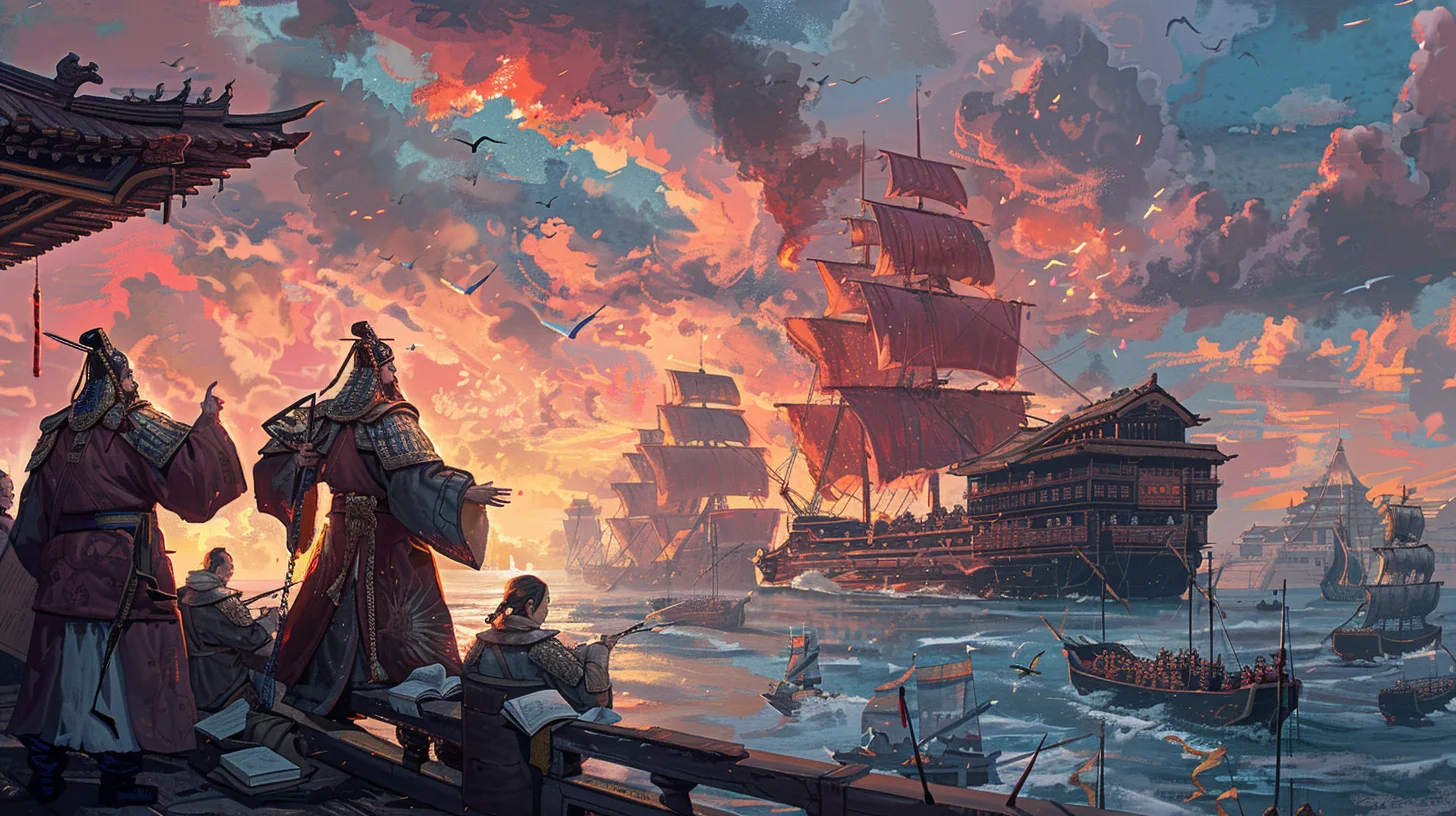
Illustration of the Ming and Qing dynasties showing Chinese officials at a harbor, watching grand sailing ships, symbolizing overseas trade, exploration, and cultural exchange.
The Ming (1368–1644 CE) and Qing (1644–1912 CE) dynasties were the final chapters of imperial China, filled with both brilliance and struggle. The Ming dynasty began with strength, rebuilding order after the collapse of the Yuan. Zhu Yuanzhang, the founding emperor, enforced discipline and restored agriculture, laying the foundation for prosperity. Later rulers, like Zhu Di, expanded influence abroad. Admiral Zheng He led great voyages across the Indian Ocean, visiting more than thirty countries, showcasing China’s naval power and opening channels of trade and diplomacy.
Ming society celebrated elegance in daily life. Scholars enjoyed refined pastimes such as painting, tea culture, and the collection of art. Great thinkers like Wang Yangming emphasized inner knowledge and moral action, shaping philosophy for centuries. Literature flourished with works such as Journey to the West and Dream of the Red Chamber, masterpieces that captured both imagination and human emotion.
The Qing dynasty, founded by the Manchu rulers, faced the challenge of governing a vast and diverse empire. Early emperors such as Kangxi, Yongzheng, and Qianlong worked to stabilize society, expand borders, and promote scholarship. Kangxi sponsored the great Kangxi Dictionary, while Qianlong oversaw the compilation of the Complete Library of the Four Treasuries, the largest collection of books in Chinese history. This monumental effort preserved China’s cultural heritage, though censorship also reflected the state’s desire for control.
Science and technology also advanced. Song Yingxing’s The Exploitation of the Works of Nature explained agriculture, industry, and mechanics, while Jesuit missionaries introduced Western astronomy and mathematics, bridging China with global knowledge. Engineering feats such as the construction of railways in late Qing symbolized the beginning of modernization, though political resistance slowed progress.
The Ming and Qing dynasties were also times of resilience. Despite wars, rebellions, and foreign pressure, Chinese culture thrived in art, architecture, and philosophy. The Forbidden City, classical gardens, porcelain, and calligraphy from this period remain iconic worldwide. Even as the Qing dynasty struggled in its final century, seeds of reform, innovation, and global exchange were planted—preparing China for a new chapter in modern history.
Comments
Loading comments...