Qin and Han Dynasties: Unifying China and Shaping Civilization
Explore how the Qin and Han dynasties unified China, reformed law, advanced science, built the Silk Road, and left a lasting mark on world civilization.
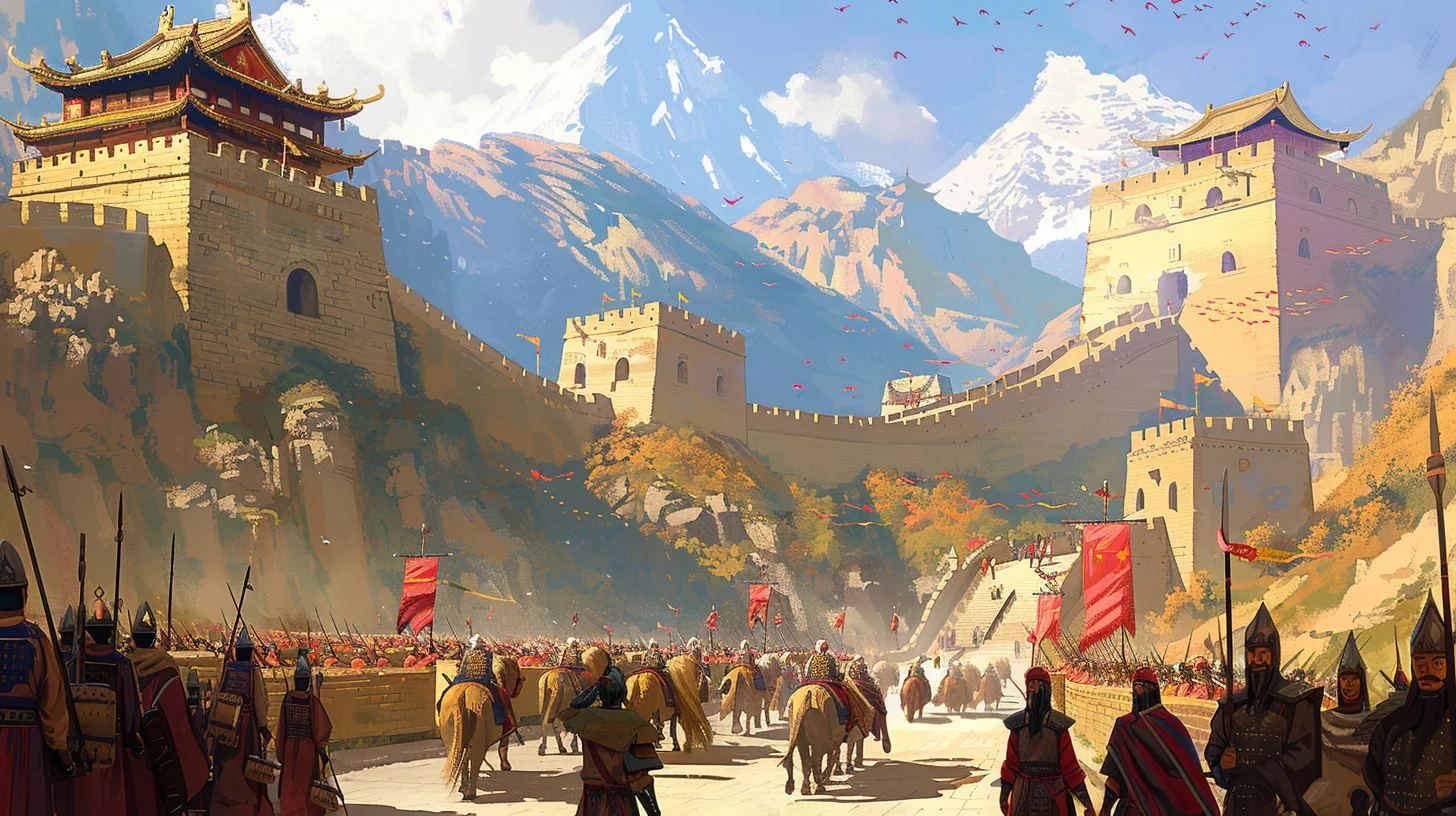
Illustration of the Qin dynasty showing soldiers gathered near fortified walls and mountain passes, symbolizing military strength and unification of China.
The Qin and Han dynasties marked a turning point in Chinese history. For the first time, China was unified under one central authority, and the foundations of empire were firmly set. The Qin dynasty (221–206 BCE), though short-lived, achieved remarkable feats under Emperor Qin Shi Huang. He standardized weights, measures, currency, and even the written script, creating consistency across a vast territory. Roads and canals were built to connect regions, while the Great Wall was expanded to protect against northern invasions. Qin’s rule was strict, guided by Legalist philosophy, and though feared, it established the model of centralized power.
One of the most dramatic events of this era was the “Burning of the Books and Burying of Scholars,” a harsh attempt to suppress dissenting ideas. Yet, despite its cruelty, Qin unification laid the groundwork for what came next—the enduring Han dynasty (206 BCE–220 CE).
The Han embraced Confucianism, shifting from Qin’s harsh Legalism toward moral governance. Confucian ideals of loyalty, filial piety, and virtue became the backbone of government and education for the next two millennia. Emperor Wu of Han expanded the empire’s frontiers, opening the Silk Road, a network of trade routes that connected China with Central Asia, India, and Rome. Along these paths, silk, paper, and ideas traveled, making Han China a vital player in global history.
Scientific and cultural achievements also flourished. The Han calendar accurately measured the solar year, and astronomy advanced with new theories about eclipses and planetary motion. Cai Lun’s improvement of papermaking gave the world one of its most important inventions, revolutionizing communication. Medicine advanced as skilled doctors treated both the imperial family and common people. Literature thrived as well, with poetry, historical records, and philosophical works reflecting the values of the time.
The Qin and Han dynasties together represent both the power of unification and the endurance of culture. Qin’s discipline and Han’s wisdom forged a civilization whose legacy of governance, science, and philosophy still influences the world today. Their story is one of ambition, innovation, and resilience—a reminder of how empires can shape human history.
Comments
Loading comments...