The Three Sovereigns: Fuxi, Shennong, and the Yellow Emperor
Discover the ancient Chinese myths of Fuxi, Shennong, and the Yellow Emperor—legendary figures who shaped culture, farming, medicine, and unity.
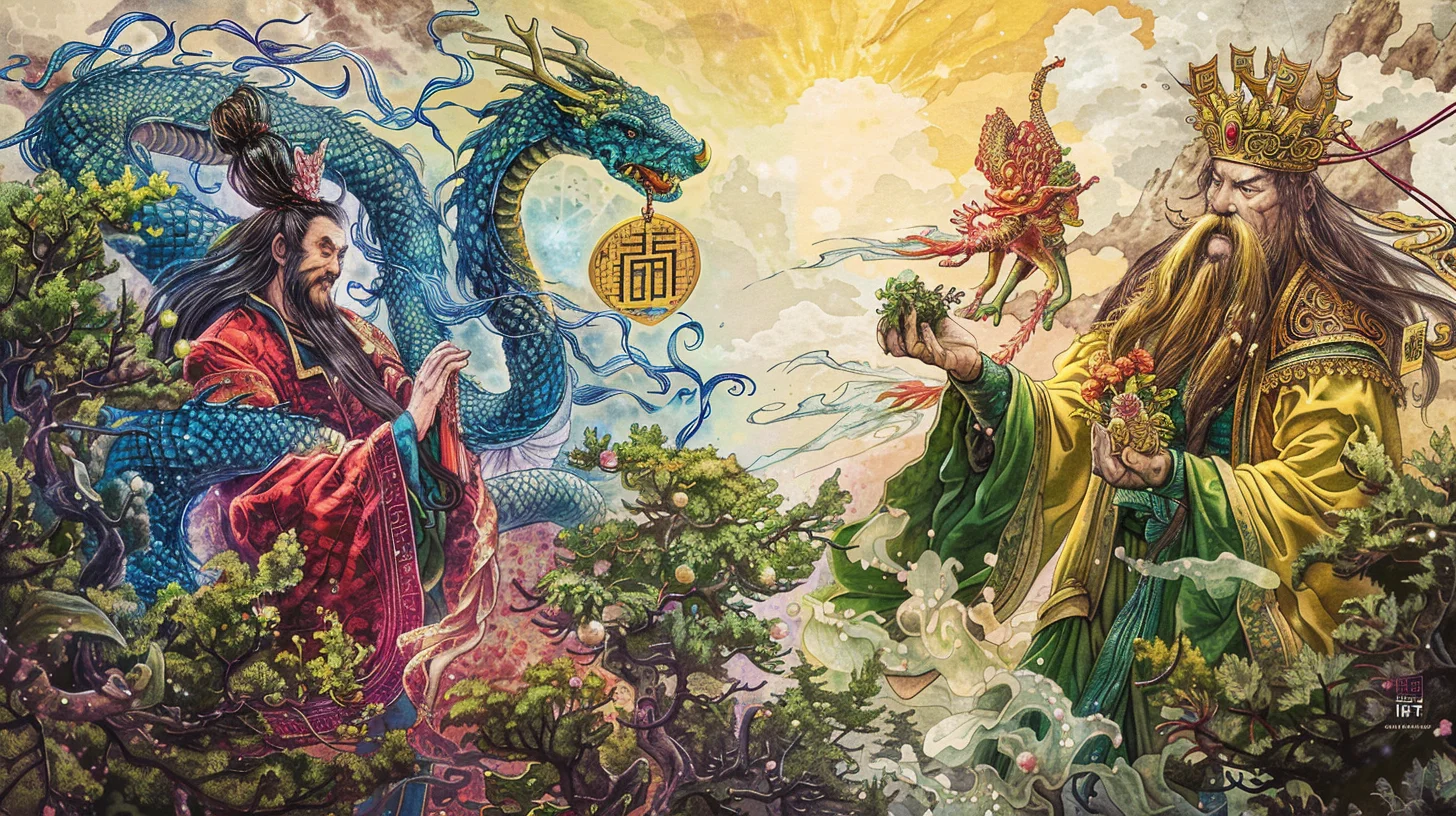
Artistic depiction of Chinese mythology showing powerful deities, a majestic dragon, and celestial light, symbolizing harmony between heaven, earth, and humanity.
In early Chinese mythology, three legendary rulers stand at the dawn of civilization: Fuxi, Shennong, and the Yellow Emperor. Known as the “Three Sovereigns,” they were more than mythic figures—they symbolized humanity’s first steps toward culture, farming, medicine, and leadership.
Fuxi is often pictured with a serpent’s body and a human face, holding tools of creation. Legends say he observed the patterns of nature and from them invented the trigrams of the I Ching, which became the basis of Chinese philosophy. He also taught people how to fish with nets, domesticate animals, and build homes. Most famously, Fuxi is linked with Nüwa, the goddess who shaped humankind, and together they were seen as the ancestors of humanity.
Shennong, the Divine Farmer, is remembered as a culture hero who gave agriculture to the people. With a body part human and part ox, he taught communities how to cultivate grains and live from the land. Shennong is also revered as the Father of Medicine. Legends describe him tasting hundreds of plants to discover their properties, sometimes suffering poison so that others could be healed. From his experiments came herbal medicine and the knowledge that food and healing are deeply connected.
The Yellow Emperor, or Huangdi, is both a cultural ancestor and a political leader. He is said to have unified tribes of the Yellow River plain, defeating rival chieftains such as Chiyou in epic battles. Huangdi introduced laws, governance, and rituals, laying the foundation for Chinese identity. Later generations traced their ancestry back to him, calling themselves the “Descendants of Yan and Huang,” honoring both Shennong (Yan Emperor) and the Yellow Emperor as their forefathers.
Together, these myths explain how humanity learned to live in harmony with the world—guided by wisdom, resilience, and leadership. Fuxi symbolizes order and knowledge, Shennong represents nourishment and healing, and the Yellow Emperor embodies unity and governance. Whether seen as real figures or symbolic ancestors, they remain central to Chinese cultural memory.
For modern readers, these stories remind us that civilization is not built overnight. It grows from generations of observation, creativity, and courage, passed down in legend until it becomes the foundation of history.
Comments
Loading comments...